
Your Team Needs Revenue Fluency!
Issue #10: February, 2026

Welcome to Issue #10 of RunTheNetwork, where I share ideas, tools and resources to build a fee-based funding model, reducing your dependency on grants.
Each month, we’ll dive deep into strategies and solutions to help you build a sustainable funding strategy!
This month, we review why revenue fluency matters, and how to start building this new skill within your team.
Table of Contents
Article: Building Revenue Fluency in a Research Organization
Quick Framework: Revenue to Research Translation Guide
Trusted Resource: Accounting for the Numberphobic
Q&A: “How can I better leverage my accountant as a strategic advisor rather than just a tax compliance resource, and should I also be working with a financial advisor?”

Building Revenue Fluency in a Research Organization
You’ve mastered the language of research, grants, and academic protocols throughout your academic career.
Now you’re running a research network adding fee-for-service offerings, and suddenly you need to understand revenue: how to price it, generate it, and manage it.
The challenge?
Your team speaks research project and grant budgets fluently, but not revenue.
The Problem: Operating in Two Worlds
As the Executive Director, you’re expected to “just know” how to generate and manage revenue from fee-based services alongside grant-funded work.
But university research environments don’t typically teach revenue concepts like pricing strategies, revenue streams, or revenue recognition. This means that you and your team excel at supporting researchers with their project budgets, but may not understand:
what revenue is
how it differs from grants
or why you need to track income from different sources.
This revenue knowledge gap creates isolation and operational risk.
Why Understanding Revenue Matters for the Whole Team
Revenue literacy enables mission sustainability. When everyone understands how service revenue supports unrestricted mission work, they see that generating income isn’t “selling out”. It’s expanding impact.
Revenue models inform decisions. Should this new service be cost-recovery or revenue-generating? Understanding how to price services, covering costs only versus adding a margin, affects staffing and strategic direction.
Shared revenue knowledge reduces bottlenecks. One person in the organization (you!) shouldn’t be the only one who understands revenue streams, pricing strategies, or how to track income from different sources.
Practical Steps to Build Team Revenue Fluency
Start with the revenue basics—explain what revenue is (income from services), how it differs from grants (unrestricted vs. restricted, operations vs. research funding), and why diversified revenue streams matter for your network’s sustainability.
Share a simple monthly revenue snapshot showing income from different sources: service fees, partnerships, and grants as separate categories.
Teach pricing in context—when developing a new service, walk through pricing decisions: cost-recovery (pricing to cover costs only) versus revenue-generating (adding a margin to support unrestricted programs).
Create pricing transparency by explaining how you arrive at quotes, showing how you calculate the service price and what portion represents cost coverage versus contribution to mission.
Build revenue literacy into roles so project leads understand which services generate revenue, how their work contributes to income, and how to track actual revenue versus projections.
From Isolation to Shared Understanding
You don’t need everyone to become revenue experts. You need a team that understands where revenue comes from, how to price services, and how revenue generation enables mission delivery.
When your team speaks both research and revenue, you’re not alone in stewarding the organization’s future.
Quick Framework
The Research to Revenue Translation Guide
How do I use it?
This is a reference page to save and open when you’re looking at your financials. It’s a glossary of essential revenue terms and what they mean in the context of your research network.
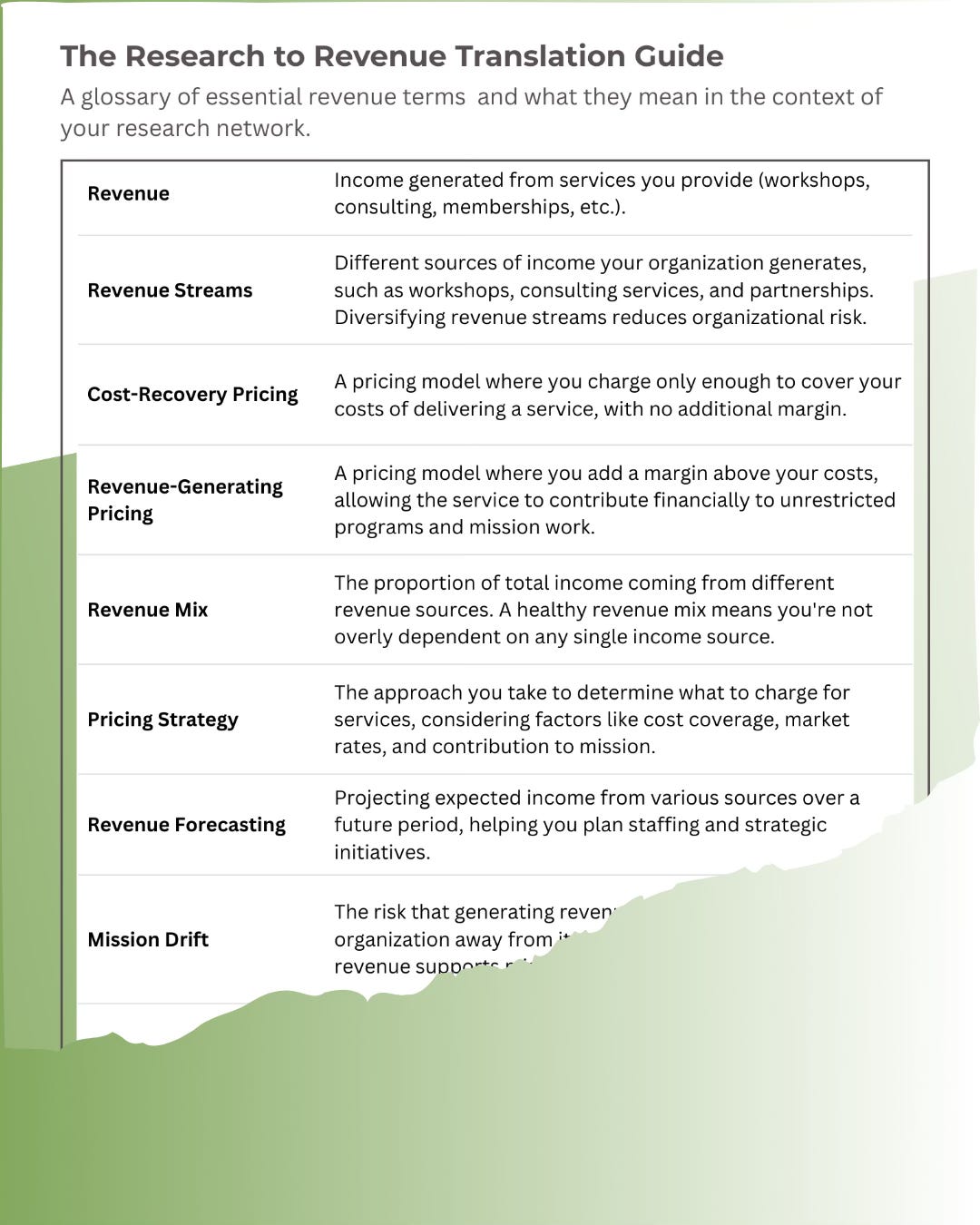
*Start Today: Download and save the pdf version of the Research to Revenue Translation Guide.

Trusted Resource
While Accounting for the Numberphobic, by Dawn Fotopulos, was written with small business owners in mind, the ideas, concepts and takeaways are also applicable to academic research organizations.
This easy-to-follow guide demystifies your company’s financial dashboard: the Net Income Statement, Cash Flow Statement, and Balance Sheet. The book explains in plain English how each measurement reflects the overall health of your business--and impacts your decisions.

Buy this book on Amazon.ca here.
Q&A
Let’s address a question you’ve been thinking about but haven’t dared to ask out loud.
“How can I better leverage my accountant as a strategic advisor rather than just a tax compliance resource, and should I also be working with a financial advisor?”
This question touches on an unspoken fear many Executive Directors face: exposing gaps in their financial knowledge. Asking how to better leverage your accountant shows that you might not be getting full value from the relationship.
There’s also uncertainty about whether you’re “bothering” your accountant with questions beyond tax compliance. Many EDs worry their accountant will be annoyed by strategic questions or will charge extra for conversations that go beyond tax filing and financial statement preparation.
Finally, there’s confusion about roles: What’s the difference between an accountant and a financial advisor? When do you need one versus the other? Asking this question means acknowledging you’re not sure who does what. And that can feel vulnerable when you’re expected to lead financial decision-making.
Strategic Questions to Ask Your Accountant
To shift your accountant relationship from compliance-focused to strategic, start asking forward-looking questions that connect financial data to operational decisions:
“If we’re considering adding a fee-for-service program, what financial metrics should we track differently?” This invites conversation about revenue recognition, pricing models, and cost allocation.
“What do our financial statements tell you about our operational efficiency compared to similar organizations?” This asks for benchmarking and interpretation, not just data reporting.
“What financial risks do you see in our current structure, and what would mitigate them?” This positions your accountant as a risk advisor, not just a record-keeper.
Accountant vs. Financial Advisor: Understanding the Difference
Your accountant focuses on historical financial data, compliance, tax preparation, and financial statement accuracy. They tell you what happened financially and ensure you meet regulatory requirements. They can provide strategic insights based on your financial statements, help with budgeting, and advise on financial structure. They’re looking primarily at your organization’s internal financial health.
A financial advisor focuses on investment strategy, long-term financial planning, and wealth management. For nonprofit or research organizations, this might mean advising on endowment management, investment policy, reserve fund growth, or planning for major capital expenditures.
For most research networks in growth mode, strengthening the strategic relationship with your accountant should come first. Once you have substantial reserves or are planning major capital investments, that’s when a financial advisor becomes valuable.
The approach and strategy outlined in this issue can be implemented independently, but you don’t have to go it alone.
Surge Advisory offers tailored services to help you develop and execute a sustainable revenue plan that aligns with your mission.
Contact us at surgeadvisory.ca to explore how we can support your transition!