
Stop Assuming You Need Separate Systems
Issue #11: March, 2026

Welcome to Issue #11 of RunTheNetwork, where I share ideas, tools and resources to build a fee-based funding model, reducing your dependency on grants.
Each month, we’ll dive deep into strategies and solutions to help you build a sustainable funding strategy!
This month, we explore the idea that fee-based services require modifications to your existing workflow, not a complete overhaul of how you operate.
Table of Contents
Article: Map First. Build Second.
Quick Framework: Process Workflow Branching
Trusted Resource: Process Mapping Guide
Q&A: “What if we've never documented our workflows before?”
Map First. Build Second.
When your research network plans to launch a fee-based service, it’s tempting to think you need to build everything from scratch.
A new funding stream means new intake forms, new review processes, new approval workflows, new project management systems—right?
Not quite.
There’s significant overlap between how you already handle cash and in-kind requests with what you’ll need for fee-based services. You’re probably duplicating work without realizing it.
Why we duplicate systems
Most organizations build parallel workflows because they’re worried about mixing different funding types.
There’s a fear that cash, in-kind, and fee-based operations need to stay completely separate.
Add to that the fact that most processes live in people’s heads rather than on paper, and it’s easy to assume that “different funding equals different everything.”
But that assumption costs you time, energy, and money.
A smarter approach: branching workflows
Instead of creating separate systems, map out what you’re already doing.
Start with your current cash and in-kind workflow. Walk through it step by step and identify which parts are actually shared across all support types—things like initial intake, mission alignment checks, and internal review processes.
Then pinpoint where the processes need to diverge. That’s usually around pricing, contracts, and accounting. These are your branch points, not reasons to build entirely separate systems.
Try this exercise
Grab a whiteboard or a piece of paper. Draw boxes for each step in your existing workflow and connect them with arrows. Now mark which steps will stay exactly the same when you add fee-based services. You’ll probably find that your initial inquiry process, mission alignment assessment, and decision-making structure don’t need to change at all.
The differences show up later: in how you generate fee quotes instead of cash or in-kind quotes, in the language of your agreements, in how revenue gets recorded. These are branch points in your workflow, not entirely new roads.
What you gain
A single workflow with strategic branching means:
less administrative burden,
easier staff training, and
lower operational costs.
Your team isn’t learning two or three different systems. They’re learning one system with a few key decision points.
You don’t need to reinvent your workflows. You need to map what exists and identify where the path splits. Start there, and you’ll save yourself months of unnecessary work.
Quick Framework
Process Workflow Branching
This diagram shows a basic example of a workflow with the different paths a research proposal submission can take.
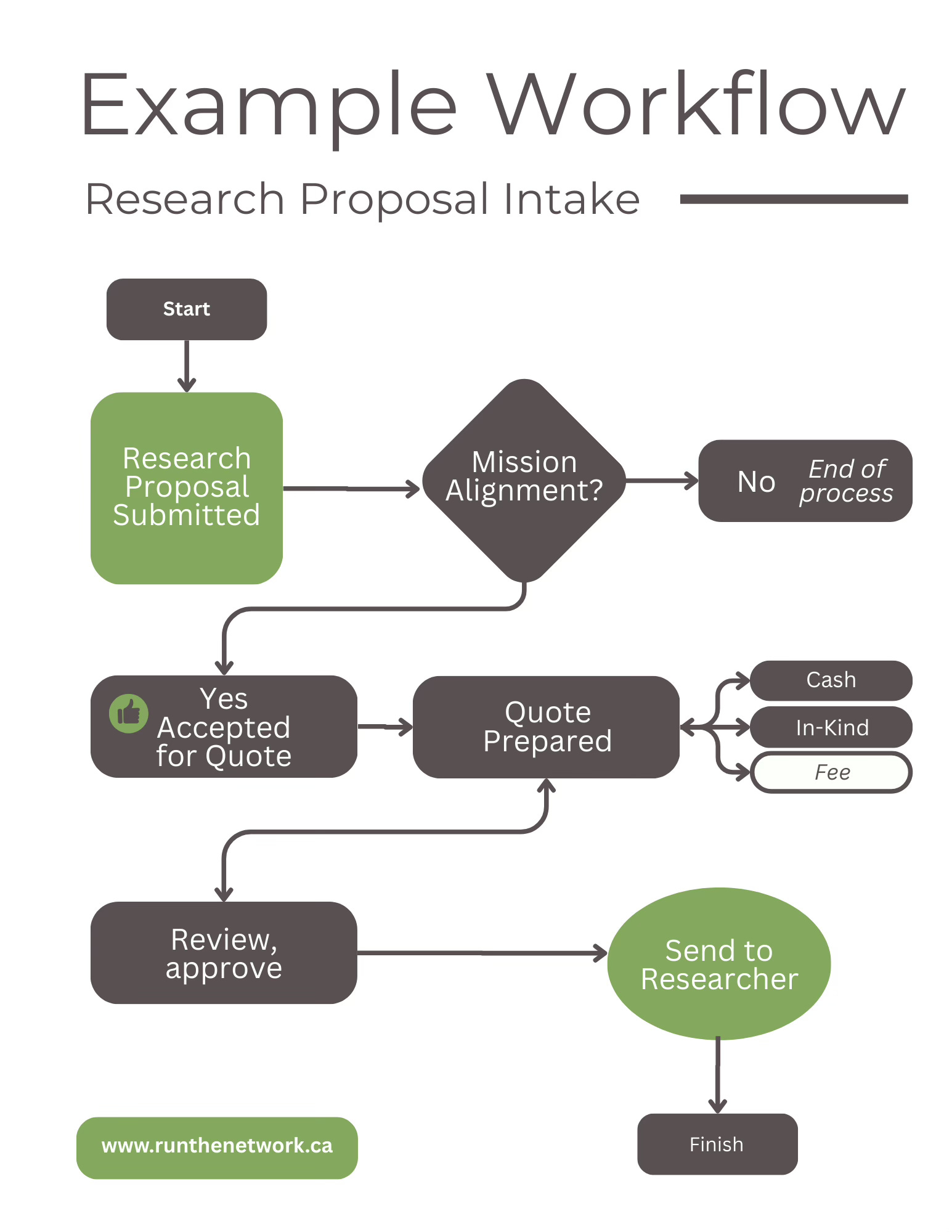
It highlights where decisions are made and how those choices affect the next steps. This example shows how mapping a process can make work easier to follow.
*Start Today: Download and save the pdf version of the Workflow Branching Example.

Trusted Resource
Asana, a project management software company, offers a comprehensive Process Mapping blog post.
“Delivery delays. Missed reviews. Duplicate work. These aren’t productivity issues—they’re process issues. When no one sees how the whole workflow fits together, even simple tasks can get stuck. That’s where process mapping comes in. It makes the invisible visible.
A process map gives you a visual representation of how work gets done. It helps teams spot bottlenecks, clarify responsibilities, and streamline even the most routine workflows. In this guide, we’ll walk through the benefits of process mapping, the symbols you’ll use to build them, and how to make a process map that helps your team work smarter.”
Read the article here.
Q&A
Let’s address a question you’ve been thinking about but haven’t dared to ask out loud.
"What if we've never documented our workflows before?"
You’re not alone.
Many research networks operate on institutional knowledge and informal processes for years before formalizing them. Your workflows exist—they’re happening every day—they’re just living in people’s heads, email threads, and sticky notes attached to monitors rather than on paper or in a diagram.
What matters now is that you’re asking questions. That awareness is the first step toward creating clarity and efficiency.
Pick one workflow to start with. Choose something routine and repeatable—like how a researcher submits a request for support, or how your team reviews proposals. Don’t try to map everything at once.
Write it out as a simple list. Walk through the process step by step: What happens first? Then what? Who’s involved? Where does it go next? What system is being used? Use plain language and capture what actually happens, not what you assume happens.
Turn that list into boxes and arrows. Each step becomes a box. Each decision or handoff becomes an arrow pointing to the next step. You can do this on paper, a whiteboard, or a simple tool like Google Slides or PowerPoint.
Your diagrams don’t need to be pretty. They need to be accurate and easy to understand. Start simple, capture what happens today, and consider where you can add branches to integrate your fee-for-service offers.
The approach and strategy outlined in this issue can be implemented independently, but you don’t have to go it alone.
Surge Advisory offers tailored services to help you develop and execute a sustainable revenue plan that aligns with your mission.
Contact us at runthenetwork.ca to explore how we can support your transition!